



[divider]
[row]
[one_half]
From severely autistic to typical 1st grader.
My son Nate started out as a beautiful, happy baby boy. He learned to talk at 13 months, but by the time he reached 18 months, things began to change. Our happy, outgoing boy quit talking. He became fussy most of the time and started fixating on certain TV shows. He also started circling round on his toes. I took him to the doctor, who insisted he was perfectly healthy. But I knew he wasn’t. Then my sister suggested I look up autism on the Internet. That was the beginning of my education on a subject about which I knew so little and now could write a book.
That night I read, “The onset of autism is often around 18 months.” “The child may start talking but then stop.” “He may spin around in circles or perform other perseverating behaviors.” The more I read, the larger the pit in my stomach grew. I knew then, as much as I hoped I was wrong, that my son was autistic. One month later I took him to Special Children’s Clinic in Las Vegas. After a day of examination by their psychologist, speech therapist and clinician, the final verdict was autism — moderate to severe.
Nate continued to worsen, becoming more distant and frustrated. I became more and more frustrated, too, knowing my child was upset and I had no idea what he wanted. At least with babies it’s predictable. They either need to be changed or fed or held. With a toddler, it is a different story. He would scream and I would try to figure out what he wanted. He’d cry and I’d cry. His distress became mine.
[/one_half]
[one_half]
[/one_half]
[/row]
The worst day I remember was when I was trying to feed Nate and couldn’t get his attention, at all. He just kept staring off into space. It was as if his bright little soul had extinguished, disappearing into the shell of a body. I tried to reach in and pull him out, to save him, but I was helpless to help. I drove him around to see the sites, because he usually liked looking out the window. But he didn’t even seem to notice. I sobbed as I drove around with the lifeless shadow of our son strapped in the car seat. Then, by the grace of God, a neighbor of ours stepped in to help. She had an autistic son who had worked with Erik Lovaas, an expert in applied behavioral therapy for autistic children. She set up a meeting with him and he agreed to take on Nate. So at age 2 1/2, his home program began. Finally we were doing something, anything.
Like other children, he screamed at first. It was more than I could bear. I had grown accustomed to a certain amount of his suffering, but the sudden increase put me over the edge. I had to leave the house during the initial workshop. I had to leave the house when the tutors were working the program with him. Eventually Nate grew more accustomed to the program, and so did I. Each month the consultant came, I could see the gains Nate was making—sometimes very slight, sometimes quite noticeable.
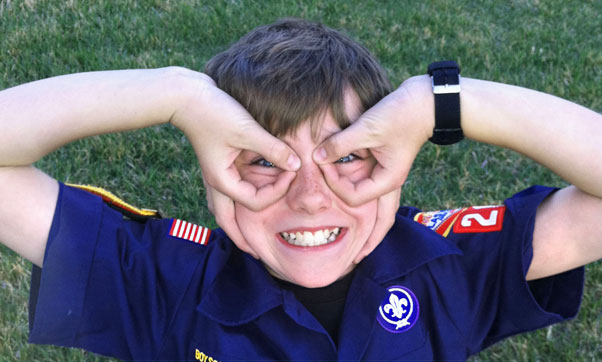
Nate is 10 years old. He has been attending regular school with “typical” kids and has not needed an aide since preschool. Nate is still not typical, and in some ways he is downright remarkable. He is exceptionally bright and has received straight A’s all year. He received his 6,500-minute reading ribbon, the second kid in his class to receive it. He plays with the other children now, and he even has a best friend. He still flaps his arms when he gets excited. But he does get excited, so excited it’s contagious. He loves the simplest things of life, noticing many things that us typical folks overlook.
He has been helped by the best of the best — friends, family, neighbors, an ABA consultant, tutors, teachers, and the like. They say it takes a village to raise a child. That has certainly been the case with Nate. And what an extraordinary village it has been.
Most importantly of all, Nate’s soul has returned with a richness and splendor that oft times make me shudder. If I am to be angry at God for allowing autism to strike Nate (and believe me, I have been) I must be at least that grateful for everything and everyone who have come to his rescue. Funny thing about life, you never really know why things happen the way they do. But for all of the strength of spirit and support that has been rallied forth in Nate’s behalf, of all the miracles and pain and growth, the hell and the heaven, I am certainly left to wonder where our lives would be without him.
[divider]